


I found the exercise to search for ID's quite enjoyable. Much like a detective trying to solve a mystery, there are clues to be found everywhere. One just has to first learn where to look.
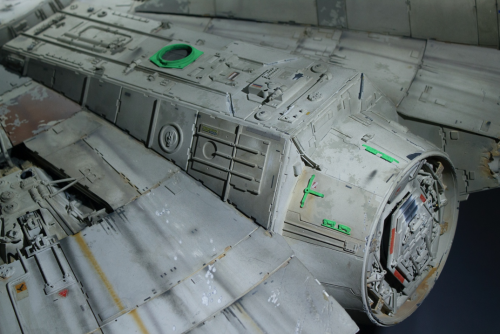
I also started to build my collection of kits, with the lofty goal of having one of everything to use as a reference for 3D modelling. Easier said than done however.
As I started to tackle modelling more kit parts I also started to consider the prospects of filling some of the gaps in the drawings provided by Andre and Joshua in 2015. And as I followed their journey through their respective build threads, I too started studying various aspects of the 5 footer, much as they did using a combination of techniques.
After countless hours of researching, measuring, modelling, checking, tweaking and redoing various elements, I now have a healthy respect for how much time goes into planning an accurate replica of this beast. I can also kind of appreciate the number of iterations that Andre and Joshua must have gone through to arrive at their current numbers.
The first no-found part that I was able to square away was the rear mandala engine vents. Having had some exposure to photogrammetry I figure that I would apply the process to this part of the model.
Not long after I had started experimenting, GEEK1138 on the RPF started his 'Millennium Falcon 5 Foot Replica' project. As with all of his work, it was fantastic and I was amazed by his speed. The rear engine vents on his model however looked out of place, perhaps too high.
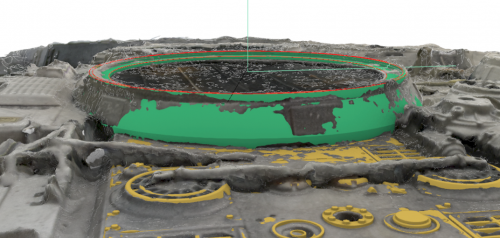
Given that I had already modelled the Panther upper hull in CAD, and using a series of photo references, I managed to pull off what I considered to be a rough but reasonable photogrammetry solve by matching the result to the Panther part as best as possible.


The vent ring was speculated to have been turned on a lathe and is a fairly simple shape. At the time I was reasonably satisfied that I had arrived at the correct overall dimensions, despite the fairly course resolution of the photogrammetry result.
Special thanks to jangelsworthy on the RPF for assisting me with checking the mesh result and encouraging me to keep pursuing these techniques.
I also started to build my collection of kits, with the lofty goal of having one of everything to use as a reference for 3D modelling. Easier said than done however.
As I started to tackle modelling more kit parts I also started to consider the prospects of filling some of the gaps in the drawings provided by Andre and Joshua in 2015. And as I followed their journey through their respective build threads, I too started studying various aspects of the 5 footer, much as they did using a combination of techniques.
After countless hours of researching, measuring, modelling, checking, tweaking and redoing various elements, I now have a healthy respect for how much time goes into planning an accurate replica of this beast. I can also kind of appreciate the number of iterations that Andre and Joshua must have gone through to arrive at their current numbers.
The first no-found part that I was able to square away was the rear mandala engine vents. Having had some exposure to photogrammetry I figure that I would apply the process to this part of the model.
Not long after I had started experimenting, GEEK1138 on the RPF started his 'Millennium Falcon 5 Foot Replica' project. As with all of his work, it was fantastic and I was amazed by his speed. The rear engine vents on his model however looked out of place, perhaps too high.
Given that I had already modelled the Panther upper hull in CAD, and using a series of photo references, I managed to pull off what I considered to be a rough but reasonable photogrammetry solve by matching the result to the Panther part as best as possible.
The vent ring was speculated to have been turned on a lathe and is a fairly simple shape. At the time I was reasonably satisfied that I had arrived at the correct overall dimensions, despite the fairly course resolution of the photogrammetry result.
Special thanks to jangelsworthy on the RPF for assisting me with checking the mesh result and encouraging me to keep pursuing these techniques.